

There's a lot of noise right now about AI in creative work. Most of it falls into two camps: breathless enthusiasm ("AI will replace designers!") or defensive dismissal ("real creatives don't use AI").
Neither position is useful. The more interesting question is practical: when does generative AI actually help produce better work for clients, and how do you build a workflow that makes it repeatable?
We recently completed a brand and website project for an early-stage biotech company. The work included developing a complete visual system with custom imagery—hero backgrounds, page textures, and looping video assets. We used generative AI extensively. Here's what we learned.
When Generative AI Makes Sense
Not every project is a good fit for AI-generated imagery. But some are ideal candidates.
Pre-product companies. Our biotech client was early-stage. There was no physical product to photograph, no lab facility to tour, no team large enough to warrant lifestyle photography. What they had was a compelling scientific concept and a need to visualize it in a way that felt credible and distinctive.
Abstract concepts. When you're representing ideas like cellular biology, energy transfer, data flow, or scientific processes, you're not documenting reality—you're creating visual metaphors. Generative AI excels at this kind of thematic exploration.
Brand-specific visual systems. Stock photography is generic by design. Custom photography is expensive and time-consuming. AI-generated imagery offers a middle path: visuals that are unique to your brand, aligned to your color palette and aesthetic, and produced at a fraction of the cost and timeline.
When Generative AI Doesn't Make Sense
Equally important is knowing when not to use it.
Products that exist. If you have a physical product, photograph it. AI-generated product images look synthetic, and customers notice. Authenticity matters.
People and team photos. AI-generated faces are getting better, but they still feel wrong. More importantly, your team is real—showing real humans builds trust in a way that fabricated portraits never will.
Anything requiring legal or regulatory accuracy. If imagery needs to be factually correct—medical procedures, safety equipment, technical specifications—AI hallucinations aren't just a quality issue, they're a liability.
The key is discernment. We're not chasing AI because it's trendy. We're using it where it genuinely produces better outcomes for clients.
The Real Differentiator: Workflow, Not Tools
Here's what most conversations about AI miss: the tools are table stakes. What matters is how you use them.
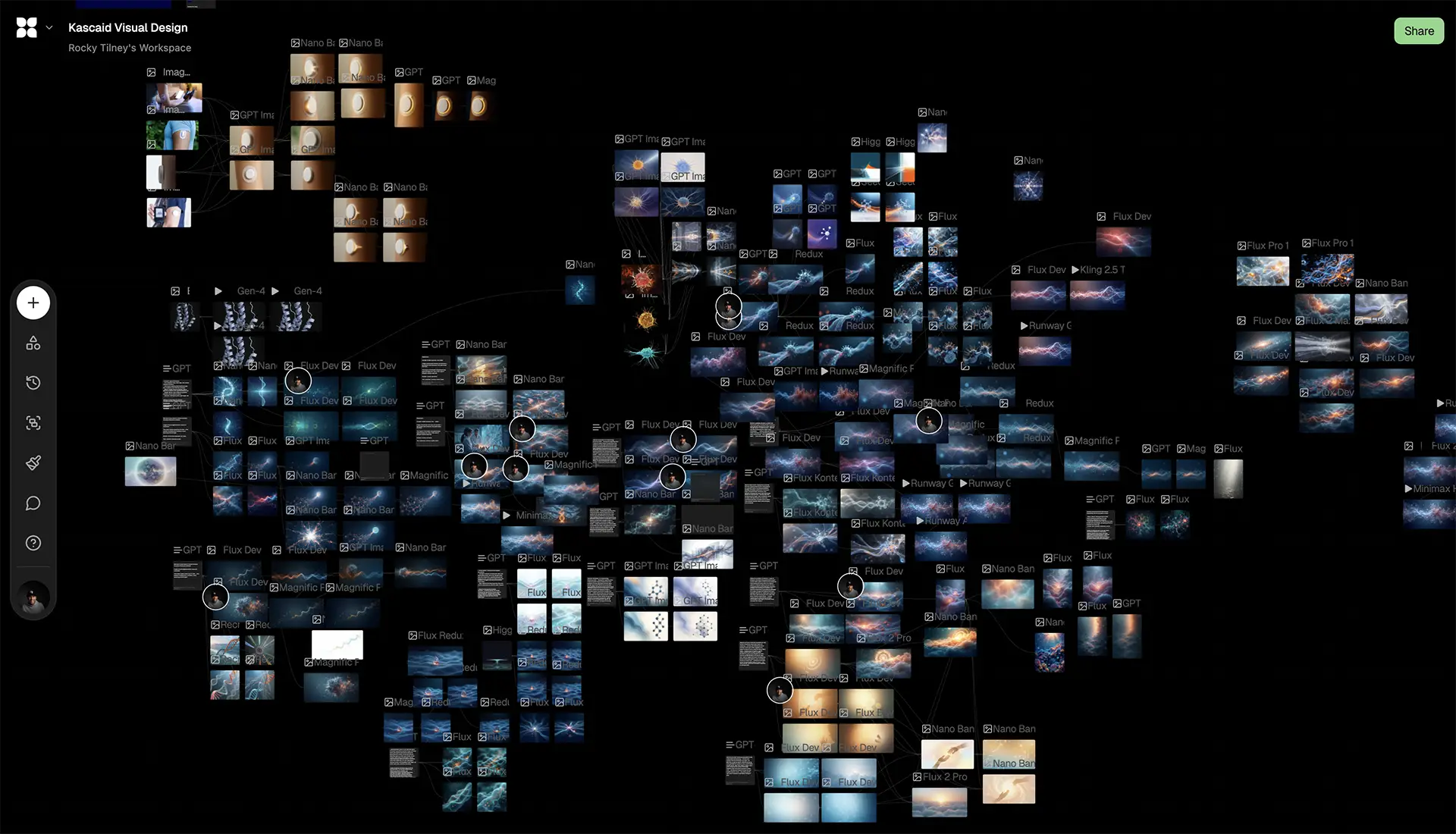
Our workflow centers on Flora.ai, which has become our go-to platform for generative imagery. What makes Flora valuable isn't any single capability—it's the access to multiple cutting-edge AI models optimized for specific tasks. Need granular editing? There's a model for that. Upscaling to high resolution? Different model. Video generation? Another model still. This flexibility lets us move between tasks without switching platforms or losing momentum.
But the real unlock is collaborative speed.
For our biotech client, we started with real scientific reference material—technical illustrations and microscopy images showing actual biology. Every AI-generated image had a foundation in real science. From there, we generated hundreds of variations based on the client's brand colors, visual tone, and thematic direction.
Across three working sessions, we shared our Flora workspace directly with the client. They watched images generate in near real-time. We could respond to feedback instantly—"more texture here," "cooler tones," "less abstract"—and produce new variations on the spot. Final assets were polished using additional tools for upscaling and refinement to achieve web-ready resolution.
This workflow changes the creative process fundamentally. Instead of presenting three concepts and hoping one lands, we can explore dozens of directions quickly, fail fast on ideas that don't work, and iterate toward assets that are exactly right. The client isn't waiting days between rounds—they're collaborating in the moment.
What This Means for Creative Work
We named our agency Upspire Labs for a reason. "Labs" reflects how we work: experimenting, testing new approaches, and bringing clients into the process as collaborators rather than spectators.
Generative AI is one tool in that lab. It's not magic, and it's not replacing the strategic thinking that makes creative work valuable. But used thoughtfully—with clear criteria for when it fits and a workflow designed for collaboration—it expands what's possible for clients who need distinctive visual identities without enterprise budgets or six-month timelines.
That feels like progress worth sharing.